

In one sentence: In Mercy, a detective accused of murdering his wife must use an AI driven courtroom system to prove his innocence within 90 minutes, despite not remembering what really happened.
In a world where AI is becoming an increasingly central part of everyday life, it is no surprise that cinema explores the potential consequences of its integration. Mercy is one of the latest films to tackle this and while it presents an intriguing concept, it ultimately struggles to process its own ideas, becoming more complex than it needs to be.

Set in the near future, the film follows Detective Christopher Raven (Chris Pratt), who finds himself restrained in a chair at Mercy, an AI courtroom, where he is accused of murdering his wife, Nicole (Annabelle Wallis). He is informed by AI Judge Maddox (Rebecca Ferguson) that he has 90 minutes to reduce his guilt percentage to a level that introduces reasonable doubt. Maddox operates purely on facts rather than emotion and the Mercy system has been designed to streamline justice, removing lengthy trials and the unpredictability of juries. Raven himself has been a firm believer in this system, even going so far as bringing the first person to be subjected to its judgement. Now, however, he finds himself on the other side of it, forced to prove his innocence using the very tools he once trusted, accessing files, reviewing CCTV and piecing together evidence. The complication is that he cannot remember the events surrounding his wife’s death. He does not know if he committed the crime. He only believes that he did not.

The concept at the heart of the film is undeniably compelling and feels particularly relevant given the growing role of AI in both personal and professional life. Initially, it seems as though the film might unfold as a contained, time-pressured mystery, perhaps in the vein of screenlife films such as Missing or Profile. However, it quickly evolves into something far more action-driven and, in doing so, begins to glitch. What could have been a tightly focused, high-stakes murder mystery instead becomes unnecessarily complicated, layering in action and broader commentary that ultimately dilute its impact.

The film briefly touches on interesting ideas around the potential sentience of AI and the relationship between human emotion and machine logic, but these themes are never fully explored. Instead, it leans towards a more conventional and somewhat predictable conclusion, offering a simplified perspective on a much more complex subject.
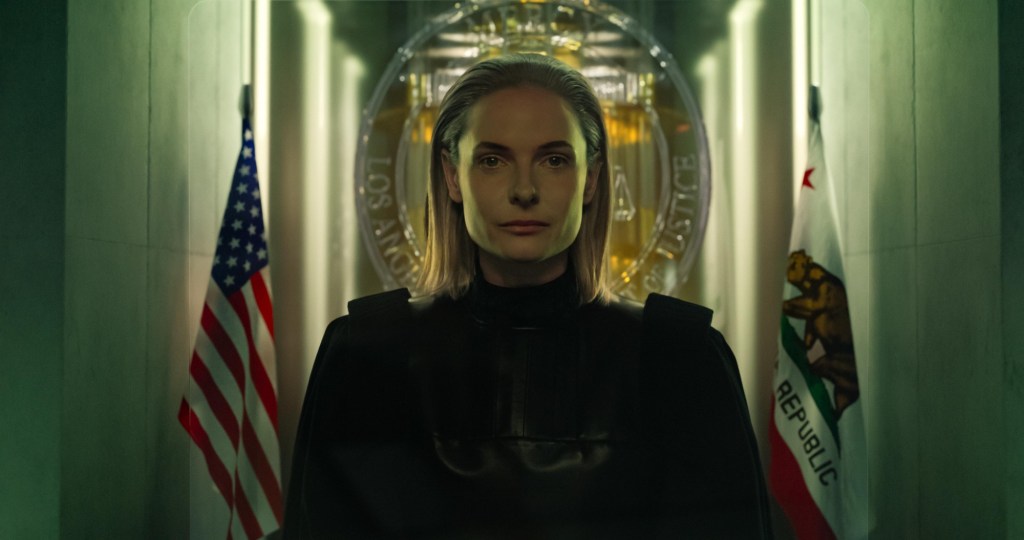
Chris Pratt leans into his familiar action-hero persona, which works to a degree, though it does make Raven’s success feel somewhat dependent on his background and connections. As an unreliable protagonist struggling with trauma and alcoholism, Raven is positioned in a way that encourages the audience to question his innocence even though he remains convinced of it. Pratt is watchable throughout, carrying much of the film’s runtime. Rebecca Ferguson delivers a strong performance as Judge Maddox, though her portrayal raises an interesting question regarding AI sentience. As the film progresses, she begins to exhibit more human characteristics of tension, hesitation, even a sense of emotional response, which feels at odds with the idea of an AI system designed to operate without feeling. At times, it becomes easy to forget she is not human, which may be intentional, but we do not get the time to dig deeper.

One of the film’s strengths is its tight timeline. The 90 minute countdown, mirrored by the film’s runtime, creates a sense of urgency that keeps the narrative moving. It is an effective device that ensures each moment feels significant, maintaining tension even as the plot becomes more convoluted.

Visually, the film offers more than initially expected. What might appear to be a contained, low budget concept expands through action sequences and screen based elements. At times, the film feels like it is trying to upgrade itself into something bigger, rather than trusting the strength of its original concept.

Overall, Mercy is a film with a strong and timely concept that never quite realises its full potential. By shifting away from its core mystery and attempting to tackle broader themes, it loses some of what makes it interesting. It remains engaging in parts, but there is a sense that a more restrained and focused approach could have resulted in a far more impactful film. Ultimately, Mercy never quite delivers on the promise of its premise.
★★½ (2.5/5)
 Rhiann’s Reels