

In one sentence: In A Pale View of Hills, a woman reflects on her life between post-war Nagasaki and 1980s England, as memories, grief and perspective intertwine to reveal a more complex and unsettling truth.
Kazuo Ishiguro’s adaptations have long been known for their subtlety, poignancy and quiet emotional weight from the restrained The Remains of the Day to the unsettling Never Let Me Go. As a result, I was particularly intrigued to see how his debut novel, A Pale View of Hills, would translate to the screen.
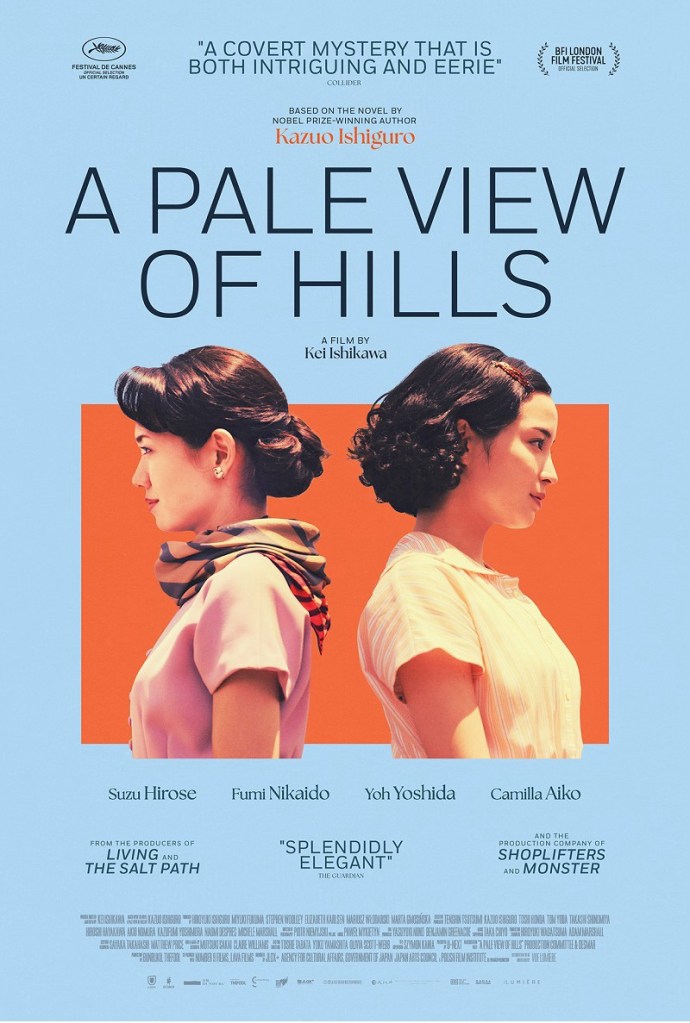
The film follows Etsuko across two periods of her life. We meet her as a young, pregnant woman (Suzu Hirose) living in post-war Nagasaki and in the 1980s as an older woman (Yoh Yoshida) in England, preparing to leave her home while reconnecting with her grown-up second daughter Nikki (Camilla Aiko), who returns for a visit. We learn that Etsuko’s first child, Keiko, has died by suicide as an adult in England, casting a shadow over the narrative and giving weight to the story of the unborn child we see in her younger years. In Nagasaki, Etsuko forms a connection with Sachiko (Fumi Nikaido) and her young daughter Mariko. This relationship that offers her an escape from her strained marriage to Jiro (Kihei Matsushita). As Sachiko prepares to leave Japan for America with her boyfriend Frank (Romain Danna), Etsuko becomes increasingly drawn into their lives. The film also introduces her father-in-law, Ogata (Tomokazu Miura), whose presence adds further depth, particularly in reflecting on the cultural and social shifts in Nagasaki following the atomic bombing. Through these interactions, we gain insight into how those physically marked by the bombing are treated differently, often facing prejudice.
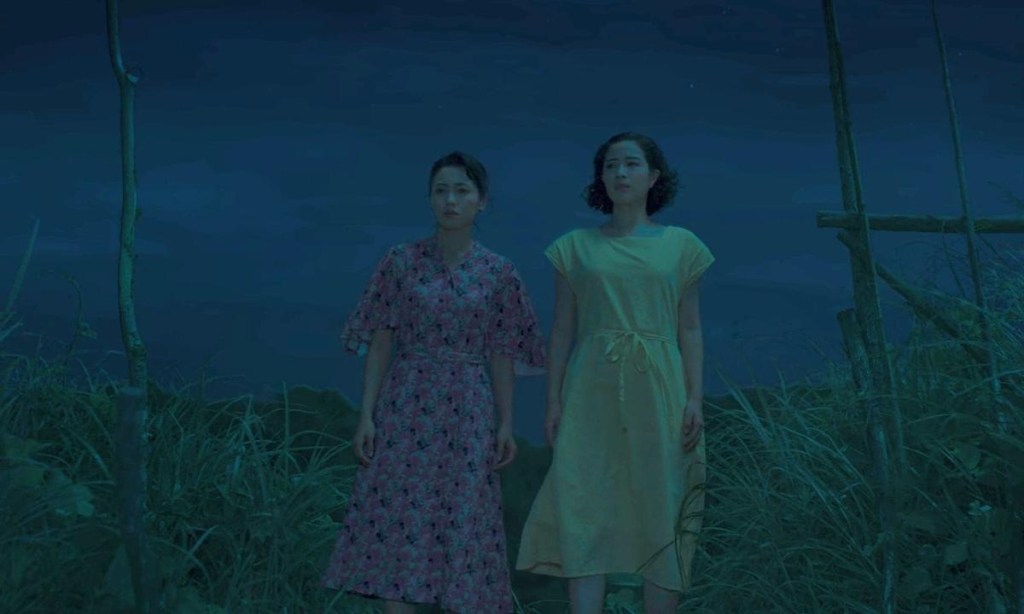
The film unfolds at a very gentle pace, which at times feels too slow to fully engage the audience. However, as Etsuko’s relationship with Sachiko deepens, the narrative becomes more compelling. However, the movie is not without its challenges. The structure and underlying mystery can feel confusing, particularly for those unfamiliar with the novel. I found myself needing to look up the ending to fully understand what I had watched, something I rarely feel compelled to do. While the novel’s subtle revelations may work beautifully on the page, they do not translate as seamlessly to screen, raising the question of whether this is a story better suited to literature than film.

Despite this, there are elements to admire. The cinematography is striking, with a beautiful use of colour and light, particularly in the Nagasaki sequences. The contrast between the warmth and texture of Japan and the colder, more muted tones of England is especially effective. The film’s use of language and cultural detail also adds a sense of authenticity, grounding the story in its setting.

The performances are strong throughout, though they are somewhat undermined by the film’s structure. Nikki’s storyline, in particular, feels underdeveloped and I would have welcomed more insight into her character. The relationship between her and Etsuko is marked by emotional distance, reflected visually through the physical space between them and the cool, detached atmosphere of the setting. The house itself feels devoid of warmth, more a space filled with unresolved grief than a place of comfort. The loss of Keiko, alongside the loss of Etsuko’s second husband, lingers heavily, creating a sense of quiet but persistent disconnection.

Overall, A Pale View of Hills is a thoughtful but niche film that will likely appeal to a specific audience. Its slow pacing, complex structure and heavy themes may not resonate with everyone. While it contains moments of beauty and strong performances, the difficulty in translating its central revelation to screen ultimately prevents it from fully landing. Ultimately, A Pale View of Hills is as elusive as memory itself. It is beautiful, haunting and difficult to fully grasp.
★★★ (3/5)
 Rhiann’s Reels