
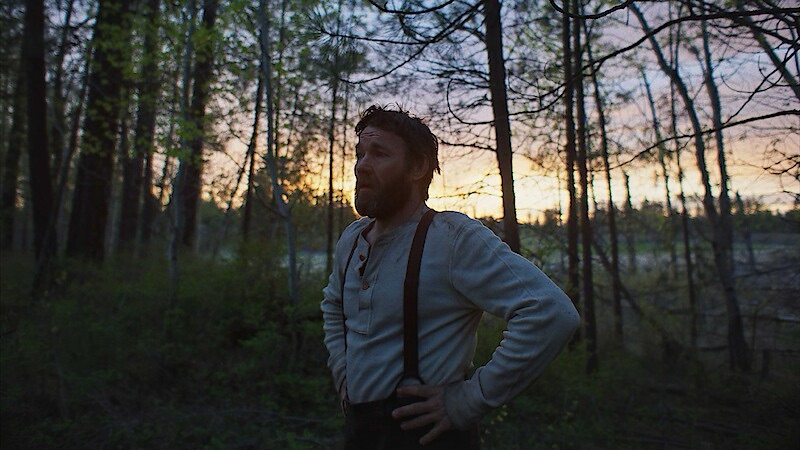
In one sentence: Train Dreams follows a solitary labourer in the early twentieth-century American West who endures profound personal tragedies while witnessing a rapidly changing world that seems to move on without him.
Netflix’s Oscar nominated entry is far removed from its usual output, offering instead a quiet, meditative character study set against the transformation of the American West in the early twentieth century. It feels unmistakably crafted for awards season with its restrained, literary and contemplative style. It is the kind of film that seems designed to appeal to Academy voters.
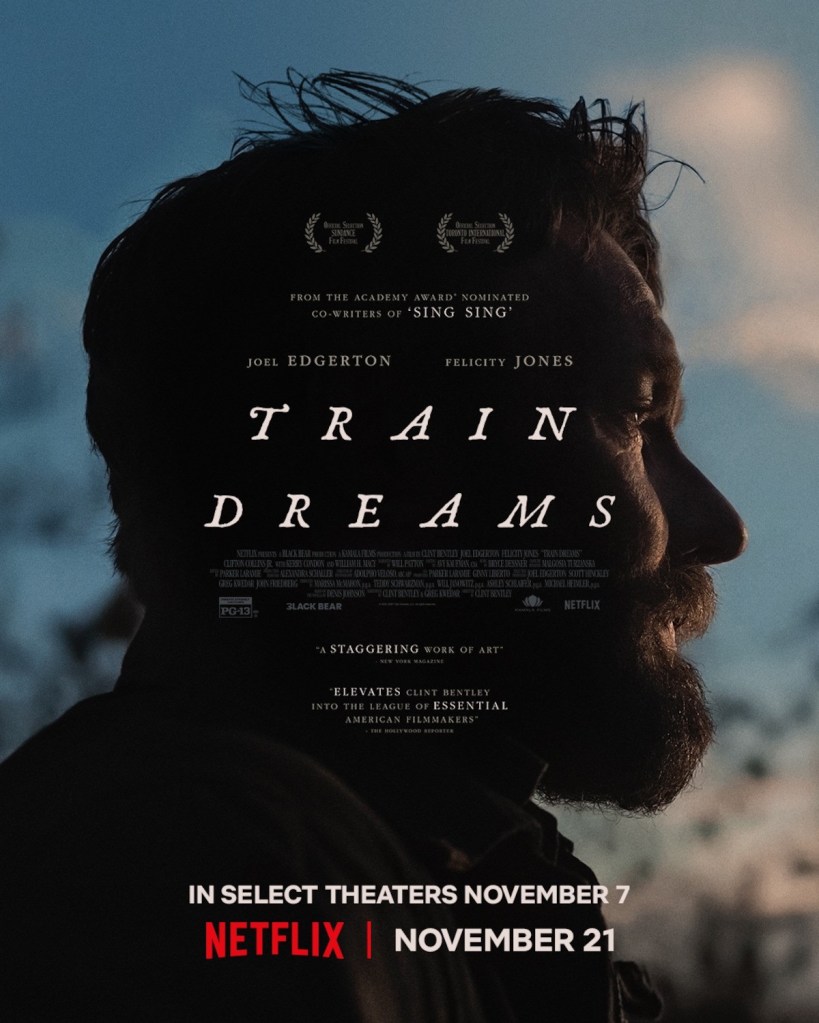
Based on Denis Johnson’s novella, Train Dreams follows Robert Grainier (Joel Edgerton), a labourer working in logging and railroad construction. His life is shaped by gruelling physical work, long stretches of silence, and a formative incident in which a migrant worker is brutally attacked after being accused of wrongdoing; an event during which Robert’s own inaction leaves a lasting mark on his conscience. His fortunes improve when he meets Gladys (Felicity Jones, who is back with another Oscar nominated film following The Brutalist), and the two marry, build a modest cabin in the wilderness and welcome a daughter, Kate. Yet Robert’s work repeatedly pulls him away from home, and tragedy arrives in multiple forms, forcing him to endure profound loss while the world around him changes at an accelerating pace.
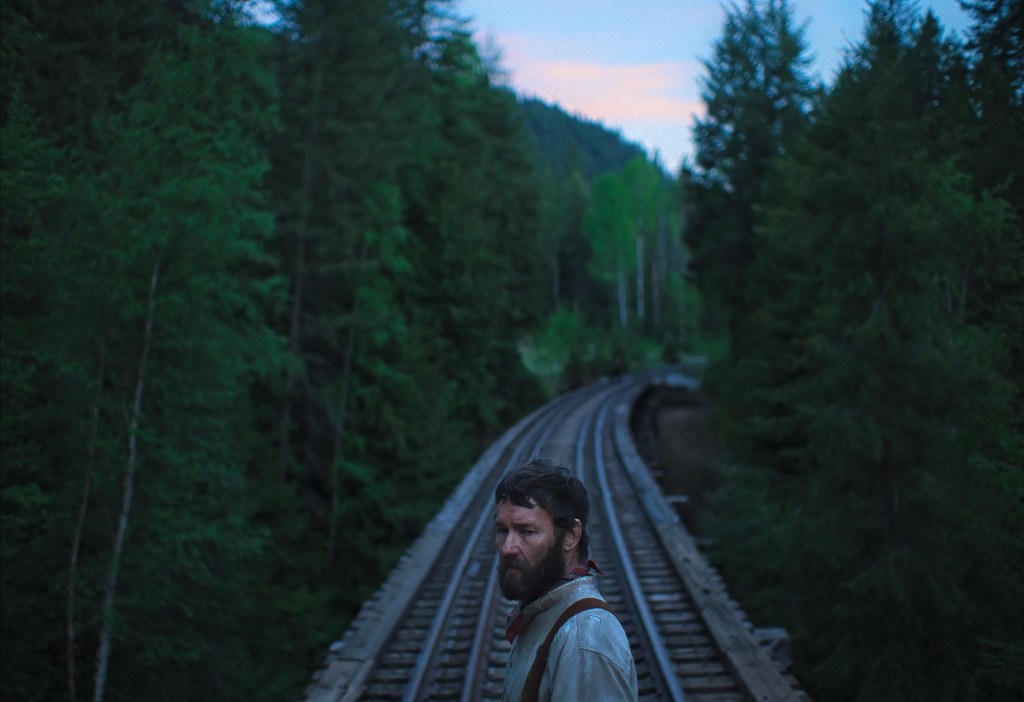
The film’s title invites several interpretations. Robert is haunted by a recurring nightmare involving railway tracks and a looming figure seemingly destined to be struck by a train. At the same time, the title may evoke the broader ‘American Dream’ embodied by the expansion of the railways, opening the country to opportunity and transformation. It could also mirror Robert’s own journey through life, steady and relentless. He experiences devastating personal losses yet continues forward with stoic determination. His expression rarely shifts, except during moments of tenderness with Gladys and Kate and in later years, his quiet endurance becomes both moving and, at times, almost superhuman in its resilience. Robert is given glimpses of later connections through Claire (Kerry Condon) and Ignatius Jack (Nathaniel Arcand) who allow Robert to vocalise his grief.

Given Robert’s isolation, narration plays a crucial role. Without it, much of his inner life would remain inaccessible and its presence lends the film a distinctly literary quality. Dialogue is sparse, reflecting both the physical exhaustion of manual labourers and the language barriers among migrant workers. As a result, the rare moments of connection carry significant emotional weight. Arn Peeples (William H. Macy) becomes one of the meaningful figures in Robert’s life, and his sudden death, a freak accident rather than a predictable occupational hazard, forces Robert to confront his own mortality. Danger is everywhere, from falling trees to unpredictable circumstances, highlighting the fragility of life in this harsh setting.
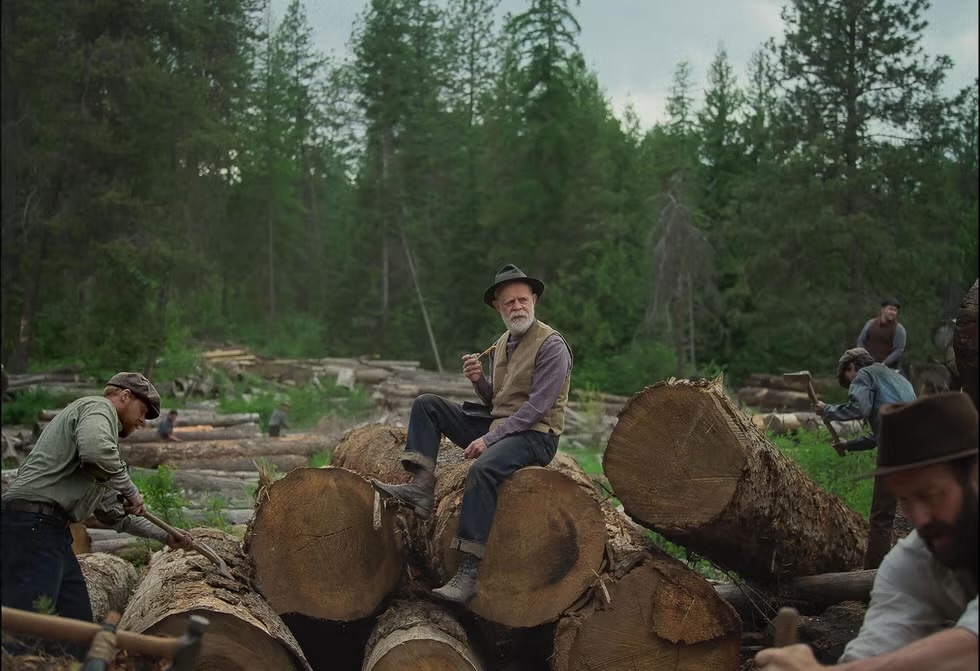
Nature itself emerges as an overwhelming presence. Towering forests, wildlife, including bears, and devastating fires all reinforce humanity’s insignificance against the vastness of the wilderness. The film quietly raises philosophical questions about unseen suffering and unnoticed lives, echoing the familiar riddle of whether a falling tree makes a sound if no one is there to hear it. In Robert’s case, much of his life unfolds in solitude so his hardships are largely unobserved by the world.

Stylistically the film deviates from mainstream storytelling. It is understated yet visually striking, prioritising atmosphere over action. The pacing will test some viewers’ patience. On first viewing, I struggled to connect with it, however, a second watch revealed a deeper appreciation for its intentions. This is not a film concerned with spectacle but with the quiet endurance of an ordinary man living through extraordinary societal change. This shift is made tangible in later scenes that reference space travel, subtly emphasising how small individual lives can seem when the universe is opened up.
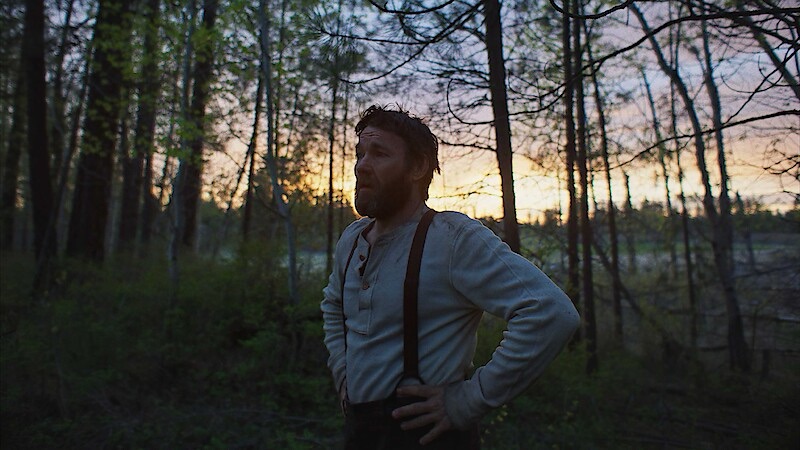
Overall, Train Dreams fits neatly into the category of traditional Oscar bait, but it offers a thoughtful perspective on a rugged and often overlooked way of life. Its minimal dialogue and contemplative pacing will divide audiences, yet its strong performances and striking cinematography ensure there is much to admire for those willing to meet it on its own terms.
★★★ (3/5)
 Rhiann’s Reels