

In one sentence: Maggie’s Plan follows a single woman determined to become a mother on her own, whose carefully laid plans unravel when she falls for a married academic.
Romantic comedies often follow a familiar formula and can feel overly predictable. Too frequently, women are portrayed as waiting for a man to arrive before their lives can truly begin. Maggie’s Plan offers something different. It centres on Maggie (Greta Gerwig), a single woman who has decided to have a baby on her own with the help of an old college friend, Guy (Travis Fimmel). Her carefully considered plan is soon upended when she meets John (Ethan Hawke), an anthropology professor who is married with children and deeply unhappy with his accomplished Columbia professor wife, Georgette (Julianne Moore). What unfolds is a screwball comedy that blends intellectual wit with surprisingly touching moments.

Maggie is not a conventional romantic-comedy heroine, which aligns perfectly with the types of characters Gerwig is known for playing. She is an academic, a Quaker and determined to become a mother on her own terms. She does not want her relationship status to dictate her choices. In many ways, Maggie is a contradiction, but that is what makes her relatable. She is complex, thoughtful and allowed to change her mind. While the film flirts with the quirky girl trope, Maggie feels more fully realised than many similar characters. She sublets a book-filled studio from a poet, dresses modestly and is introduced as compassionate in the film’s opening scene when she helps a blind man cross a busy New York street.

The film’s quirkiness is heightened by its intellectually dense dialogue. Maggie works at a university, is the daughter of academics and meets John in this environment. Her friend Felicia (Maya Rudolph) works there too, while Georgette is a tenured professor. Their conversations are filled with elevated, academic language that can feel occasionally inaccessible. This tone may disengage some viewers, but the performances are strong enough to carry the audience through. Even when the dialogue becomes knotty, context, expression and timing keep scenes engaging. At times, the language is deliberately used for humour, most memorably when Guy awkwardly deploys the word “behooves.”

The film presents its female characters as notably stronger than their male counterparts, which may reflect Rebecca Miller’s direction. Based on a story by Karen Rinaldi, later adapted into the novel The End of Men, the film explores whether women can truly have it all. Maggie’s Plan suggests that compromise is inevitable. Maggie sacrifices aspects of her independence for love. Georgette struggles to balance her demanding academic career with family life. Even the seemingly more stable couple, Tony (Bill Hader) and Felicia, are far from perfect, often providing comic relief while revealing their own flaws.

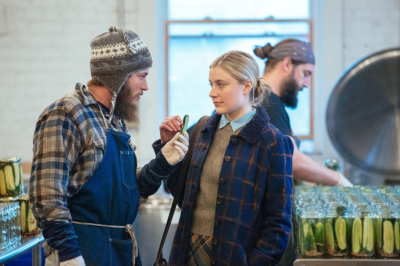
Ethan Hawke is particularly effective as John, a deeply disagreeable man-child who seems stuck in a perpetual state of academic adolescence. He uses charm, vulnerability and storytelling to elicit sympathy and plays into the idea that women might want to rescue or fix him. Guy, by contrast, is gentle and earnest, running a thriving pickle business. Despite the Viking beard and questionable outfits, Travis Fimmel’s natural charisma and piercing blue eyes still shine through. Tony functions as something of a Jiminy Cricket figure for Maggie, offering guidance, though his status as a former boyfriend leaves you questioning whether his advice is always entirely in Maggie’s best interests.
Ultimately, Maggie’s Plan explores how love, ambition and personal plans evolve over time. It recognises that change is often the only constant and, in doing so, gently subverts the expectations of the romantic comedy genre.

Overall, it is an enjoyable and intelligent watch that avoids many tired rom-com tropes. You may even come away having discovered a new word or two along the way.
★★★½ (3.5/5)
 Rhiann’s Reels