
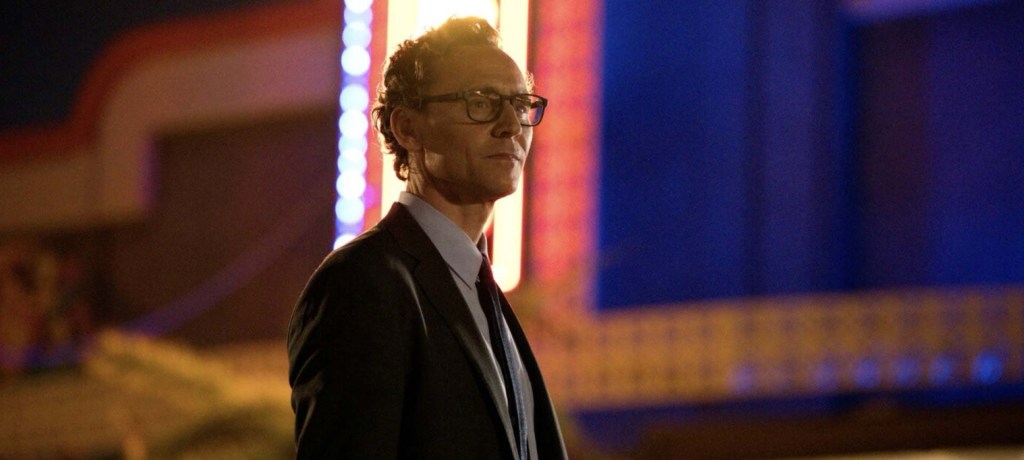
In one sentence: The Life of Chuck explores an ordinary life in reverse, reflecting on memory, loss and the significance of human connection.
With Stephen King’s latest adaptation, The Life of Chuck, I expected something uplifting. After all, the marketing spoke of a life-affirming story filled with wonder. Instead, I found myself sitting with a knot of melancholy. Perhaps that is the risk when a film promises affirmation; it can still tell the truth about life, which is not always comforting.

The story unfolds in three acts, moving backwards through time. We begin in the third act as the world is unravelling. The internet collapses, which for many seems the final straw. Entire coastlines fall into the sea, sinkholes open without warning and large numbers of people are ending their lives. Amid the chaos, messages appear everywhere thanking Charles Krantz (Tom Hiddleston) for thirty-nine years of service. Through the eyes of Felicia (Karen Gillan) and Marty (Chiwetel Ejiofor), we watch this surreal breakdown before realising that this dying world is Charles’ mind, collapsing as he dies of a brain tumour.

The second and first acts take us back through moments of Charles’ life. We see him as a boy and man who finds solace in dance and in the first act we discover why. After the death of his parents in a car accident, Charles is raised by his grandparents (Mia Sara and Mark Hamill). His grandmother teaches him to dance in the kitchen while his grandfather guards the mysterious and seemingly haunted room upstairs. These earlier scenes offer warmth but also carry a heaviness as we know the path his life will take. I found it difficult to feel uplifted when each childhood moment was shadowed by his tragic fate.

The film includes several enchanting sequences, particularly the act two dance number where Hiddleston clearly enjoys showing off the moves he demonstrated in a resurfaced Chatty Man interview. Benjamin Pajak gives a standout performance as young Charles and the scene where his teacher (Kate Siegel, wife of the film’s Director, Mike Flanagan) discusses Walt Whitman’s Song of Myself is particularly touching. She places her hands on either side of his head and tells him that what lies between them contains multitudes. It is a striking moment that links beautifully back to the film’s third act.

Nick Offerman’s warm and unmistakable voice as the narrator provides essential context and for the film’s unusual structure. The rich, saturated colours in the happier scenes offer visual contrast when the story moves toward darker territory.

For me, the marketing suggested something uplifting, only for the film to reveal a much more bittersweet tone that aligns more closely with Stephen King’s sensibilities. The final moments chilled me and left me with an unexpected heaviness. I appreciate the message about time, gratitude and the fleeting nature of life, but I could not help but feel sadness rather than affirmation.
★★★½ (3.5/5)
 Rhiann’s Reels