
In one sentence: A Different Man follows aspiring actor, Edward, living with a facial disfigurement who undergoes an experimental procedure to change his appearance, only to find his life complicated when he becomes fixated on a role inspired by his former self.
Aaron Schimberg’s genre-defying film A Different Man offers a fresh and unsettling perspective on identity in a world obsessed with appearances.
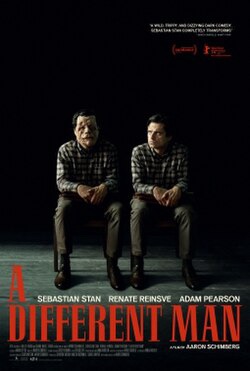
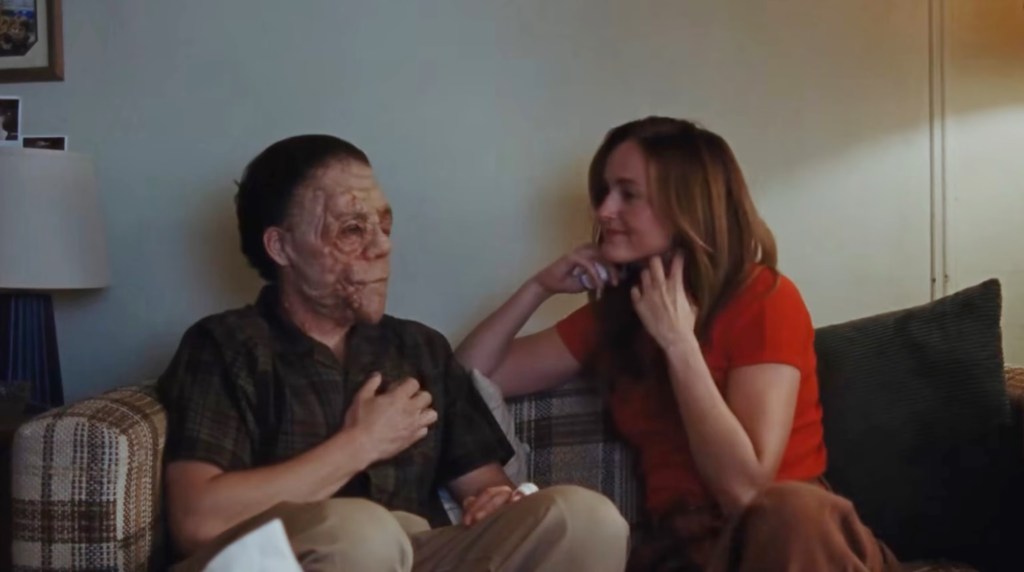
We follow Edward, a timid, small-time actor living with Neurofibromatosis, a condition that causes tumours to grow across his face, affecting both his vision and hearing. I was genuinely surprised to discover that I was watching Sebastian Stan rather than Adam Pearson. Both Stan’s performance and the makeup artistry are remarkable. Edward is made to feel different and unlovable, and the film captures humanity at its most uncomfortable through the stares, smirks and intrusive questions he faces. These moments are deeply affecting and give a real sense of what daily life might be like for someone living with facial disfigurement.

Edward meets his new neighbour, Ingrid (Renate Reinsve), a playwright who, though initially shocked by his appearance, becomes increasingly friendly, bordering on flirtatious. When movers accidentally damage Edward’s front door, Ingrid offers to repair it, painting it a bold shade of red with paint droplets that resemble blood leading to her own door. Later in the film, she describes herself as someone who leaves destruction in her wake, and she is often dressed in red (lipstick, clothes, accessories) making her motives feel mysterious from the outset.
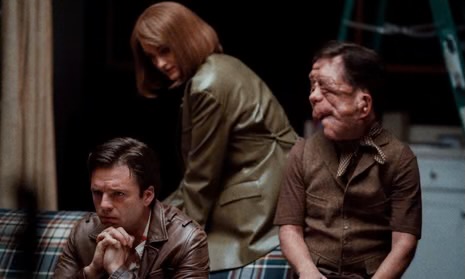
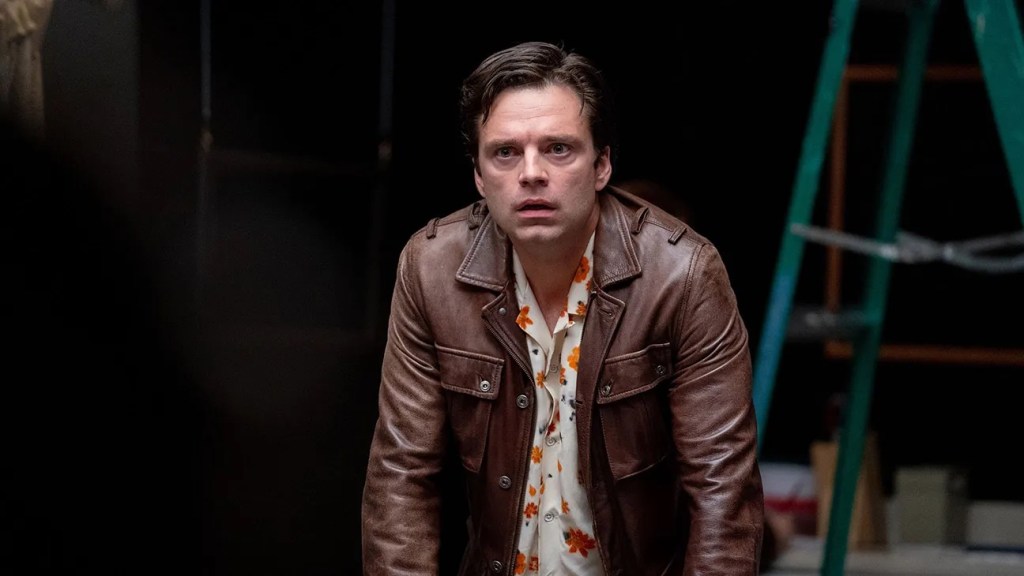
Edward is offered a place in an experimental medical trial that could completely cure his Neurofibromatosis. He accepts, although part of me wondered whether it was truly what he wanted, or if he was simply doing what he thought he should. What follows is a sequence of striking body-horror imagery as the treatment takes effect. Edward’s skin peels away with writhing pain and blinding headaches until Sebastian Stan’s Hollywood-perfect features are revealed, however, still paired with Edward’s crippling awkwardness.
Reinventing himself as ‘Guy’, Edward tries to leave his old self behind. When he crosses paths with Ingrid again, he discovers that she has written a play called Edward based on his life. Guy longs to reclaim his former identity, and this conflict only deepens with the arrival of Oswald, played by Adam Pearson, who has Neurofibromatosis in real life. Oswald is confident, charismatic and effortlessly likeable. He draws admiration and affection from others with ease, singing karaoke, joking, living freely, everything Guy once wanted and still wants. His jealousy overwhelms him as Oswald begins to take the life Guy thought was his. The transformation is chilling, and by the film’s end, the timid man we met at the beginning feels like a distant memory.
I can honestly say I have never seen a film quite like A Different Man, and perhaps that is unsurprising given that it was distributed by A24. The company is known for unconventional storytelling, and this movie is no exception. Its cinematography, structure and emotional tone are a far cry from formulaic Hollywood fare. In my virtual film club, opinions were split; some found it captivating, others said it pushed their limits, but that is what makes cinema so engaging. Not everyone sees the same thing, and the discussions that follow are what make films like this linger.
The film explores themes of transformation, the uncanny and the doppelgänger, with a small nod to Kafka’s Metamorphosis. These ideas of self-destruction and reinvention give the story real depth and emotional charge.
Toni Morrison’s The Bluest Eye repeatedly features throughout the film. The novel follows a young Black girl’s descent into madness as she longs for blue eyes, exposing the damage caused by beauty standards and societal pressure to conform. Schimberg, who was born with a cleft palate, weaves his own experience into the story. He even appears briefly in the film as an ‘unattractive man’ with a beautiful girlfriend, a moment that draws comments from Guy’s colleagues and adds a personal layer to the narrative. His lived experience gives Edward’s insecurities a universality that resonates far beyond the specifics of his condition.
Ultimately, A Different Man suggests that outer beauty cannot heal inner wounds. It delivers this message through sometimes extreme imagery, but the questions it raises about identity, perception and self-acceptance are powerful. The film stays with you, inviting reflection long after the credits roll and that, to me, is the mark of great cinema.
★★★★½ (4.5/5)
 Rhiann’s Reels